
Mineral variety Healing crystal
Synthetic Opal
✦ Lab-Grown Opal (no traditional lore) ✦
Crystal lore: 🎨 Creativity
Also known as: Gilson opal, Lab opal
⚗ Chemical makeup
SiO₂·nH₂O
lab-grown opal (some with resin)SiOHRarity◆◆◆◆◆Common ?
Silica mineraloid.
Lab-grown imitation of natural Opal.


👁️ What It Looks Like
- Color
- Color varies with locality and impurities; see the photo for a typical example
- Shape & form
- Shape varies; commonly seen as polished or tumbled pieces
- Typical size
- Size varies widely by locality; specimens are commonly palm-sized or smaller
- Luster
- Luster varies with polish and locality
📜 Key facts
| Age | Man-made since the 1970s (Gilson opal was first sold in 1974) |
|---|---|
| Origin & sources | Laboratory-grown, e.g. Gilson (France) and Kyocera (Japan). |
| Composition | Lab-grown silica spheres (some contain resin), arranged like natural precious opal |
How it forms
Silica spheres are settled and bonded in a lab to copy natural play-of-colour. Many show a 'lizard-skin' or chicken-wire pattern under magnification, which helps tell them from natural opal.
Mineral data: see Opal.
✨ Opal family

Black OpalMineral variety

Blue OpalMineral variety

Boulder OpalMineral variety
Chocolate OpalMineral variety
Common OpalMineral variety

Crystal OpalMineral variety

Dendritic OpalMineral variety
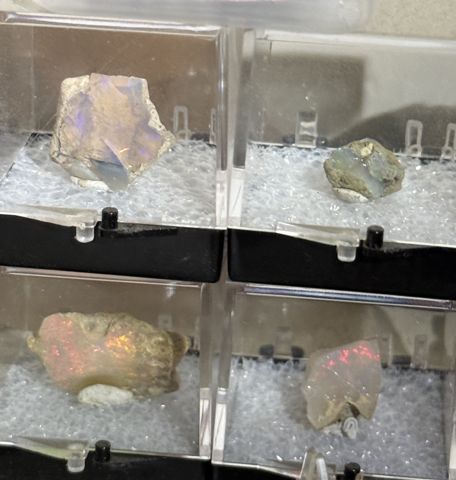
Ethiopian OpalMineral variety

Fire opalMineral variety

Green OpalMineral variety
Honey OpalMineral variety

HyaliteMineraloid variety
Matrix OpalMineral variety
OpalIMA mineral species
Opal Doublet & TripletMineral variety

OpaliteNatural glass

Opalized FossilFossil
Pink OpalMineral variety

Precious opalGem material

Virgin Valley OpalMineral variety

White OpalMineral variety

Wood OpalMineral variety
✨ Metaphysical & Folklore
These are traditional and folk beliefs from crystal lore. They are not scientific or medical claims – crystals are not a substitute for professional care.
Lab-grown opal shares opal's traditional associations with creativity in crystal lore.
💞 Pairs well with (traditional pairings)
OpalPaired in tradition for creativity, with Opal bringing inspiration as well.
 Blue Lace AgateBoth carry the theme of peaceful expression, so together they're thought to reinforce it.
 Lapis LazuliA natural partner for self-expression; Lapis Lazuli also adds wisdom.
 AmethystWorks the same Crown chakra, adding meditation.
 HematiteA grounding root stone to balance synthetic opal's high, spiritual energy.
Learn more
Mineral variety
BlueMulticolor & Iridescent
Crown
Creativity
Healing crystal