
Black Opal
✦ Queen of Opals ✦
Crystal lore: 🛡️ Protection🔮 Intuition🎨 Creativity
SiO₂·nH₂O
precious opal, dark bodySiOHRarity◆◆◆◆◆Rare ?
Silica mineraloid.
OrangeTealBluePurpleBlackMulticolor & Iridescent
Variety of Opal.


👁️ What It Looks Like
- Color
- White, gray, black, orange, blue and others
- Shape & form
- Massive, veins and nodules; no crystals
- Typical size
- Gems small to large; rough pieces to hand-sized
- Luster
- Waxy to glassy; transparent to opaque
- Notable look
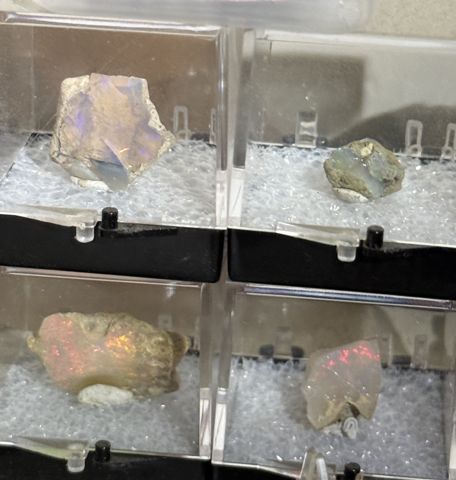
- Precious opal flashes spectral color
Can also be found with: ✨Play-of-color
Based on standard references · source · effect source📜 Key facts
| Age | About 100 million years old (Cretaceous host rocks); the opal itself formed later |
|---|---|
| Origin & sources | Lightning Ridge, New South Wales, Australia, the classic source. |
| Composition | Precious opal with a dark body tone, so the play-of-colour stands out. Opal is hydrated amorphous silica (SiO₂·nH₂O), Mohs 5.5–6.5. |
How it forms
Silica-rich water seeped into cracks, cavities and fossils, then slowly evaporated. Tiny silica spheres settled out. In precious opal they are stacked in a neat, regular grid that diffracts light into play-of-colour. In common opal they are jumbled.
Mineral data: see Opal.
🌍 Where it's found
- Type locality
- Notable source / deposit
- Country of origin
Marker positions are approximate (region or locality level). Type localities from Wikidata; notable sources curated by Crystopedia.
✨ Opal family




✨ Metaphysical & Folklore
These are traditional and folk beliefs from crystal lore. They are not scientific or medical claims – crystals are not a substitute for professional care.
Australia's national gemstone is linked in lore to protection and to drawing out one's hidden potential.
💞 Pairs well with (traditional pairings)
 ObsidianA natural partner for protection; Obsidian also adds truth.
 Tiger's EyePaired in tradition for protection, with Tiger's Eye bringing confidence as well.
 AgateBoth carry the theme of protection, so together they're thought to reinforce it.
 Black TourmalineA natural partner for protection; Black Tourmaline also adds grounding.
 Clear QuartzClear quartz is the traditional amplifier, said to boost black opal's protection.