
Boulder Opal
✦ Stone of the Outback ✦
Crystal lore: 🌳 Grounding🎨 Creativity🔥 Confidence
SiO₂·nH₂O
precious opal in ironstoneSiOHRarity◆◆◆◆◆Common ?
Silica mineraloid.
Variety of Opal.


👁️ What It Looks Like
- Color
- White, gray, black, orange, blue and others
- Shape & form
- Massive, veins and nodules; no crystals
- Typical size
- Gems small to large; rough pieces to hand-sized
- Luster
- Waxy to glassy; transparent to opaque
- Notable look
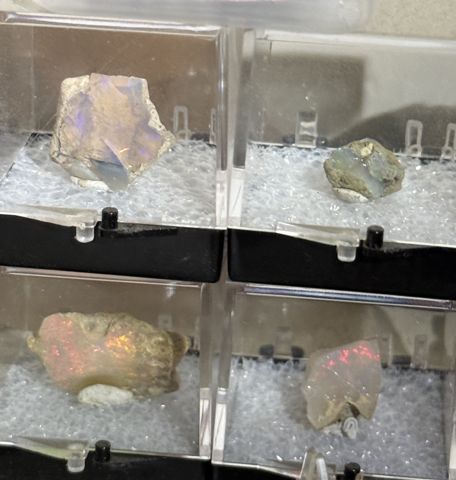
- Precious opal flashes spectral color
Can also be found with: ✨Play-of-color
Based on standard references · source · effect source📜 Key facts
| Age | Cretaceous host rocks |
|---|---|
| Origin & sources | Western Queensland, Australia (Winton, Quilpie and Yowah). |
| Composition | Precious opal in seams within ironstone boulders, usually cut with the brown ironstone backing left on. Opal is hydrated amorphous silica (SiO₂·nH₂O), Mohs 5.5–6.5. |
How it forms
Silica-rich water seeped into cracks, cavities and fossils, then slowly evaporated. Tiny silica spheres settled out. In precious opal they are stacked in a neat, regular grid that diffracts light into play-of-colour. In common opal they are jumbled.
Mineral data: see Opal.
🌍 Where it's found
- Type locality
- Notable source / deposit
- Country of origin
Marker positions are approximate (region or locality level). Type localities from Wikidata; notable sources curated by Crystopedia.
✨ Opal family




✨ Metaphysical & Folklore
These are traditional and folk beliefs from crystal lore. They are not scientific or medical claims – crystals are not a substitute for professional care.
Opal veins in ironstone are linked in lore to grounding, strength and steady creativity.
💞 Pairs well with (traditional pairings)
 Black TourmalineBoth carry the theme of grounding, so together they're thought to reinforce it.
 HematiteA natural partner for grounding; Hematite also adds focus.
 JasperPaired in tradition for grounding, with Jasper bringing stamina as well.
OpalBoth carry the theme of creativity, so together they're thought to reinforce it.
 Clear QuartzLifts and clarifies boulder opal's grounding energy; clear quartz is said to amplify any stone.