
Halite
✦ The Salt Stone ✦
💧 Don't Get Wet🪶 Soft, Scratches Easily
Crystal lore: ✨ Cleansing🛡️ Protection🌊 Calm
NaCl
NaClRarity◆◆◆◆◆Common ?
Mineral form of sodium chloride.

👁️ What It Looks Like
- Color
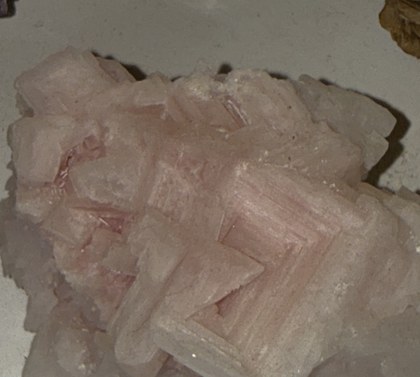
- Colorless, white, pink, blue or gray
- Shape & form
- Cubes and granular masses
- Typical size
- Crystals millimeters to many centimeters
- Luster
- Glassy; transparent to translucent
- Notable look
- Table salt; it dissolves in water
Properties
Scratches with a fingernail.
| Chemical formula | NaCl |
|---|---|
| Elements | Na, Cl |
| Crystal system | Cubic |
| Mohs hardness | 2 |
| Density | 2.225 g/cm³ |
| Streak | white |
| Color | — |
| IMA symbol | Hl |
| Nickel–Strunz class | 3.AA.20 |
“—” means no reliable value in Wikidata yet. Check Mindat for full data.
Care & Handling
- 💧 Don't Get Wet Halite is rock salt and dissolves in water.
- 🪶 Soft, Scratches Easily Mohs 2: softer than a steel knife, so it scratches easily. Store it apart from harder stones.
🌍 Where it's found
- Type locality
- Notable source / deposit
- Country of origin
Marker positions are approximate (region or locality level). Type localities from Wikidata; notable sources curated by Crystopedia.
💡 Good to know
Halite colours: clear to white is pure salt. Pink to red usually comes from salt-loving microbes (archaea), as at Searles Lake, California. Blue to violet comes from radiation-damaged colour centres, often next to sylvite. Orange or brown usually comes from iron oxide or clay inclusions.
✨ Halite family



✨ Metaphysical & Folklore
💧 Elixir safety: Halite (rock salt) dissolves in water.
These are traditional and folk beliefs from crystal lore. They are not scientific or medical claims – crystals are not a substitute for professional care.
Rock salt is associated with cleansing and protection.
💞 Pairs well with (traditional pairings)
 CalciteBoth carry the theme of energy cleansing, so together they're thought to reinforce it.
 SeleniteA natural partner for cleansing; Selenite also adds peace.
 LepidoliteWorks the same Heart & Crown chakra, adding calm.
 MalachiteBoth carry the theme of protection, so together they're thought to reinforce it.
 HematiteA grounding root stone to balance halite's high, spiritual energy.
Learn more
- Halite on Mindat.org
- Wikipedia article
- Wikidata item Q5314 (source of this page's data – you can correct it there)